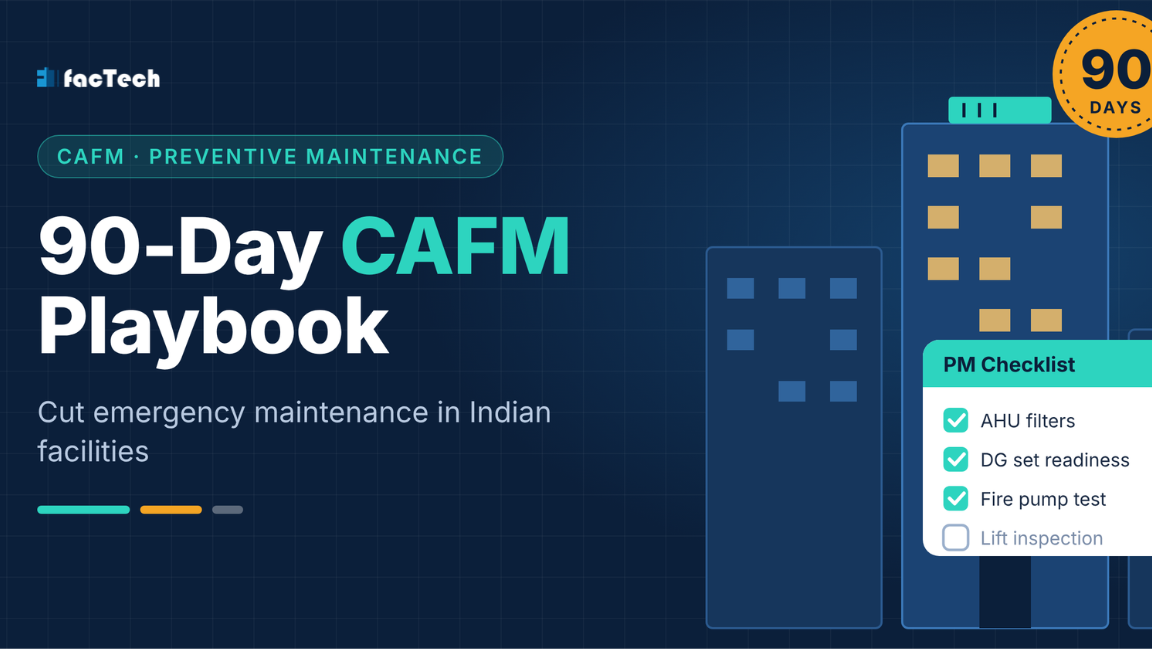
90-Day CAFM Playbook to Cut Emergency Maintenance in Indian Facilities
Another breakdown call!
The facilities manager picks up, knowing that one technician is already on an AHU and another is chasing an electrical fault. Three more complaints arrived by lunch. Instead of preparing for maintenance, the team spends its day fixing one failure after another, and the cycle repeats tomorrow.
This “firefighting” mode lets small faults grow into expensive emergencies. Backlogs build, overworked technicians burn out, and occupants lose patience. To Reduce Emergency Maintenance CAFM software breaks the cycle.
CAFM keeps a digital record of every asset, triggers preventive maintenance automatically and gives technicians mobile checklists. This guide covers the cost of reactive maintenance, how CAFM reduces it, a 90-day rollout plan for Indian facility teams, ready-to-use PM checklists and the KPIs to track. Rollout takes about 90 days; expect the full results within 6 to 9 months.
The High Cost of Reactive Firefighting
Reactive maintenance costs far more than the repair bill. When a team works in “fix-it-when-it-breaks” mode, four hidden costs follow.
- Higher Repair and Overtime Costs. Urgent repairs typically cost three to five times more than planned maintenance, because of technician overtime, rush-delivered spares and emergency contractor rates.
- Operational Downtime. When a server-room cooling unit, hospital lift or boiler fails without warning, work stops. Lost working hours, tenant complaints and missed deadlines eat into revenue.
- A Growing Maintenance Backlog. Technicians skip filter changes and belt inspections to attend emergencies, and those tasks slip to next week. After a few months, hundreds of postponed jobs cause more breakdowns.
- Overworked Technicians. Repeated emergency callouts lead to unpaid overtime, band-aid fixes and high staff turnover, which means losing the people who know your equipment best.
How CAFM Reduces Emergency Maintenance
CAFM moves a facility team from reacting to breakdowns to planning around them. Four mechanisms work together.
- Complete Asset Visibility. CAFM creates a digital register of every chiller, air handling unit (AHU), diesel generator (DG set), lift, fire pump, and UPS. Each record holds installation date, warranty status, OEM manual and repair history.
- Automated preventive maintenance (PM) triggers. Work orders are generated from calendar intervals (weekly, monthly, quarterly) or runtime meters such as generator hours and pump cycles. Nobody has to remember.
- Mobile execution. Technicians receive work orders on a phone or tablet. They scan a QR code on the equipment, follow step-by-step instructions, record readings, attach before and after photos and close the job on site.
- Early-warning monitoring. When integrated with a Building Management System (BMS) or IoT sensors, CAFM can alert the team when, for example, cooling tower fan vibration spikes or transformer temperature trends upward, often days before a failure.
CAFM, CMMS and IWMS: what is the difference?
- CMMS (Computerized Maintenance Management System) focuses on maintenance work orders and asset history.
- CAFM covers maintenance plus space, helpdesk, vendor and compliance management for buildings.
- IWMS (Integrated Workplace Management System) extends CAFM with real estate, lease and capital project management.
For most Indian facility teams that want to cut breakdowns, a CAFM or a CMMS with strong PM scheduling is the right starting point.
The 90-Day CAFM Implementation Playbook
You do not need to shut down the building or hire more staff. A structured 90-day rollout moves a team from mostly reactive work to scheduled operations, and the full KPI gains follow over the next three to six months.
Days 1 to 30: Build the Asset Foundation
- Tag and Register Critical Assets First. Skip the office chairs. Start with equipment that causes the most disruption when it fails: water pumps, chillers, AHUs, DG sets, transformers and lifts.
- Build Standard Task Templates. Create an inspection checklist for each asset type, covering the steps, safety gear and expected time. SFG20 is a widely used UK maintenance task library (published by BESA); use it as a reference and adapt the tasks to Indian equipment, climate and statutory requirements.
- Train Technicians on the Mobile App. Cover QR scanning, reading instructions and closing work orders with a photo.
Days 31 to 60: Launch Scheduled PMs and Control the Backlog
- Automate weekly and monthly schedules. Switch on recurring work orders and balance the load across shifts, so technicians have a realistic mix of planned jobs and helpdesk tickets.
- Add a 10% schedule buffer. VIP visits, vendor delays and weather happen. A 3-day grace window on a 30-day PM cycle keeps small delays from becoming panic.
- Link spare parts to PM jobs. Storekeepers can pre-build kits of filters, belts and lubricants against scheduled work orders.
Days 61 to 90: Review data and eliminate repeat failures
- Find the “bad actor” assets. On day 60, use CAFM reports to see which assets raise the most emergency tickets, then change their inspection interval or replace worn parts.
- Hold a weekly 15-minute backlog review. Every Monday morning, check which work orders are done and which are overdue.
- Share early wins with management. Show the drop in breakdown calls and the faster response times to secure long-term support.
Why CAFM Matters for Indian Facility Teams
Indian buildings face pressures that a generic maintenance plan misses. A good CAFM setup builds them in.
- Monsoon and Water Ingress. Schedule pre-monsoon checks of drainage, sump and basement pumps, roof waterproofing, electrical panels and lift pits before the rains arrive, not after the first leak.
- Voltage Fluctuation and DG Dependence. Frequent power dips and outages make DG sets and UPS units critical. Track DG running hours and trigger service by runtime, not by calendar.
- Statutory Compliance. Fire NOC conditions, the National Building Code of India (NBC 2016) fire and life-safety provisions, state lift inspection acts and pollution control board requirements for DG sets and STPs all need records. CAFM keeps timestamped inspection logs and certificate expiry reminders ready for audits. Check the rules of your state and city.
- AMC and Outsourced Vendors. Many buildings rely on annual maintenance contracts. CAFM lets you attach SLAs to work orders, track vendor response and closure times and hold contractors to the contract.

Sample Preventive Maintenance Checklists for Commercial Buildings
These sample checklists show how standard tasks appear in a CAFM mobile app. Adapt them to your equipment, OEM manuals and local regulations.
Air Handling Unit (AHU)
- Isolate the power at the local starter panel and apply lockout-tagout (LOTO): lock and tag the isolator, then verify that the unit is de-energised.
- Remove the pre-filters and fine filters. Check for tears and heavy dust, and wash or replace them based on pressure-drop readings.
- Inspect the fan motor V-belts for cracking, glazing or slack tension. Tighten them and check pulley alignment.
- Inspect the condensate drain pan and line for algae, sludge or blockage. Flush the line and drain the tray to prevent ceiling leaks.
- Listen for unusual noise and check for heat at the blower shaft bearings. Lubricate as specified.
- Tighten any loose control panel terminals and record the running motor current (amps) in the CAFM mobile form.
Diesel generator (DG set): weekly readiness
- Check engine lubricating oil, radiator coolant and the diesel level in the day tank.
- Check that the battery terminals are secure and free of corrosion. Record the charger output and the resting battery voltage.
- Check the jacket water heater temperature. Look for oil or fuel leaks around hoses, gaskets and the floor bundle.
- Start the DG set and run it for 10 to 15 minutes. Enter frequency (Hz), oil pressure, coolant temperature and exhaust smoke condition in the CAFM app.
Fire and life safety
- Monthly: Check the pressure gauge, seal and expiry date of every fire extinguisher.
- During safety drills: check emergency exit lights and public address systems.
Lifts, water treatment and plumbing
- Every six months: clean overhead and underground water tanks, and check STP and WTP pump motors for abnormal noise or vibration.
- Weekly: check sensor taps, flush valves and drainage in washrooms to prevent water wastage and tenant complaints.
- Monthly: schedule third-party or OEM inspections of passenger and service lifts, including door sensors and emergency intercoms.
Measuring Success: KPIs Before and After CAFM
Teams moving from paper and spreadsheets to structured CAFM workflows typically see gains across these KPIs within 6 to 9 months.
| KPI | Before CAFM | After CAFM | What It Means |
|---|---|---|---|
| Emergency work orders (% of total) | 45% to 60% | 10% to 15% | 70%+ drop in sudden callouts |
| PM compliance | 50% to 65% | 90% to 96% | Assets cared for on time |
| Planned vs. unplanned maintenance | 40 : 60 | 85 : 15 | Teams control their own schedule |
| Mean time to repair (varies by asset class) | 6 to 12 hours | 1.5 to 3 hours | Asset history and parts available instantly |
| Annual emergency vendor spend | Baseline | 25% to 40% lower | Budgets become predictable |
| Technician wrench time | 25% to 30% | 50% to 60% | Less walking and searching, more fixing |
Making Planned Maintenance a Long-Term Habit
Software gives your team the tools. Daily discipline keeps emergency calls low year after year.
- Protect PM Time. Give planned work orders the same priority as urgent tenant complaints. Block out mornings or dedicate certain technicians to scheduled inspections.
- Enforce Mobile Sign-Offs. Require timestamped photos and numerical readings (temperature, pressure, voltage) before a PM work order can be closed. This stops “pencil-whipping”, where tasks are marked done without inspection.
- Run a Root Cause Analysis on Every Breakdown. Record the failure code in CAFM. If the same motor fails twice in six months, revise its PM checklist.
- Keep Checklists Relevant. Ask technicians for feedback. Remove steps that waste time, and inspect problem assets, such as a pump that struggles every summer, more often.
- Review the Backlog Weekly. A 15-minute meeting between supervisors and lead technicians covers late work orders, missing parts and workload balance across shifts.
- Reward Prevention, Not Heroics. Recognise technicians who keep PM compliance at 95% or higher in their zones, not just the ones who stay late to fix a failed chiller.
- Make Reporting Easy. Place QR codes in washrooms, corridors and work areas so occupants can report a flickering light or dripping tap in about 10 seconds.
- Share a Simple Monthly Scorecard. When everyone sees how regular care keeps occupants happy, proactive maintenance becomes the norm.
Conclusion
Emergency maintenance falls when guesswork and paper records give way to structured, data-driven routines. In 90 days, you can register your critical assets, automate preventive schedules, put checklists on technicians’ phones and start clearing the backlog. The full KPI gains follow within 6 to 9 months.
Ready to move your team from firefighting to planned maintenance? Book a demo and update your system.
FAQs
How is CAFM different from CMMS?
A CMMS focuses on maintenance work orders and asset history. CAFM adds space, helpdesk, vendor and compliance management for buildings.
How quickly can CAFM reduce emergency maintenance callouts?
Using CAFM can reduce emergency maintenance callouts very fast if you properly follow the checklist and provide the correct data.
Why is emergency repair more expensive than planned maintenance?
Urgent failures typically cost three to five times more, because of technician overtime, rush shipping for spares and premium emergency contractor rates.
How does CAFM stop technicians skipping checklist steps?
The mobile app requires technicians to scan the equipment QR code, enter live readings and upload timestamped photos before they can close a work order.
Can a small facility team use CAFM?
Yes. Start with 20 to 50 critical assets and a handful of recurring PM schedules, then expand as the team gets comfortable.
Ready to Transform Your Facility Management?
See how Factech automates maintenance, assets, and compliance in one intelligent platform.
Let's Talk
Have questions about our AI-powered solutions? Our team is here to help you digitize your facility operations.