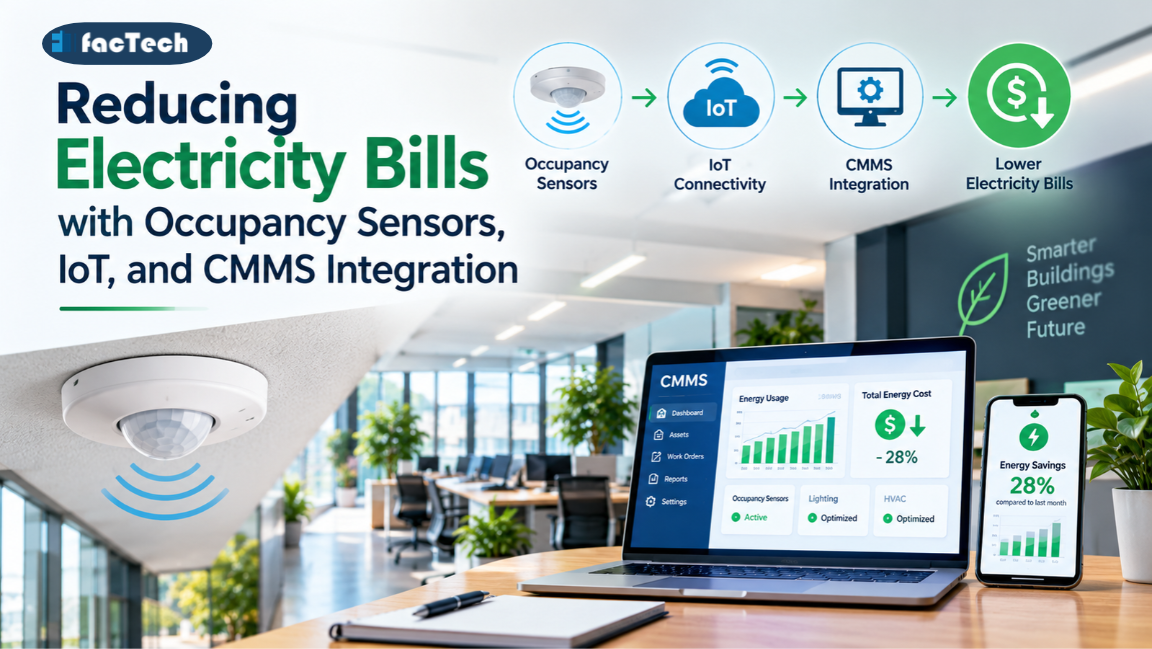
Reducing Electricity Bills with Occupancy Sensors, IoT, and CMMS Integration
India is the second most populated country of the world and it is consuming electricity at its peak and there is a need to save resources like electricity for sustainable usage. The Sensors, IoT, and CMMS Integration works with a network of linked devices which are also connected with a server. The sensors capture the signals emanating from the integrated devices/equipment utilized for real time analytics, thus providing insights. By mixing occupancy sensors IoT and CMMS organizations can automate energy savings, remove waste and improve building performance. This article explains how occupancy sensors, IoT and CMMS work together to lower electricity bills and upgrade facility management.
The Problem: Hidden Energy Waste, in Modern Buildings
The issue is that facility electricity is being wasted. To start solving this it’s important to know where the waste happens. In commercial buildings energy use is based on old schedules instead of real people being present.
Rigid HVAC timers: Heating, ventilation and air conditioning systems often run at power from eight in the morning to six in the evening every single day no matter if employees are traveling, working from home or on holiday. This means HVAC equipment wastes energy for hours when no one’s in the building.
Overlit Workspaces: The lights above are very bright in offices in cafeterias and in breakout rooms even when no one is there anymore.
Phantom Loads: Office machines, vending machines and small motors keep using electricity all the time because no one takes the time to turn them off.
Relying on workers to manually flip light switches and adjust thermostats is inefficient. This waste of workers and money hurts the bottom line. To stop this leak buildings need automated intelligence that responds instantly to real‑time human presence. Buildings will save money when they use intelligence.
What Are Occupancy Sensors and IoT?
To understand how energy savings work we must look at the two front-line technologies: occupancy sensors and the Internet of Things.
Occupancy sensors
Occupancy sensors are smart devices that you mount on ceilings or walls. They can tell if a room is being used now. Depending on the model they use:
Passive Infrared PIR Detects body heat and physical movement.
Ultrasonic Waves Sends out waves to detect motion in a room even, around corners.
Dual Technology Sensors Combines PIR. Ultrasonic sensing to eliminate false triggers ensuring lights or climate controls only stay active when people are truly present.
The Internet of Things (IoT)
Sensors cannot lower utility bills if they operate in isolation. This is where the Internet of Things comes in. The Internet of Things means a network of devices that have software, computing power and internet links letting them talk to each other over the web.
When an occupancy sensor sees a room is empty it turns that fact into a data packet and sends it quickly without delay through an Internet of Things gateway, to a central management software platform.
The Role of a CMMS in Today’s Energy Management
IoT sensors might collect data and carry out instant commands, but the hub of facility operations is a Computerized Maintenance Management System (CMMS).
In the past, maintenance teams have utilized CMMS only for logging repair tickets, tracking work orders, and managing spare parts inventories. Modern cloud-based CMMS products nevertheless link directly with building automation systems and IOT networks.
How a CMMS enhances facility efficiency:
Centralized Asset Tracking: CMMS keeps records of every light fixture, air handler, boiler and electrical panel in the facility.
Automated Work Orders: If an IoT sensor says that a room is too hot even though no one is there the CMMS can automatically create a work order for the maintenance team to check it out.
Performance History is a tool that shows how much energy has been used over time. It helps managers see which machines are causing utility bills.
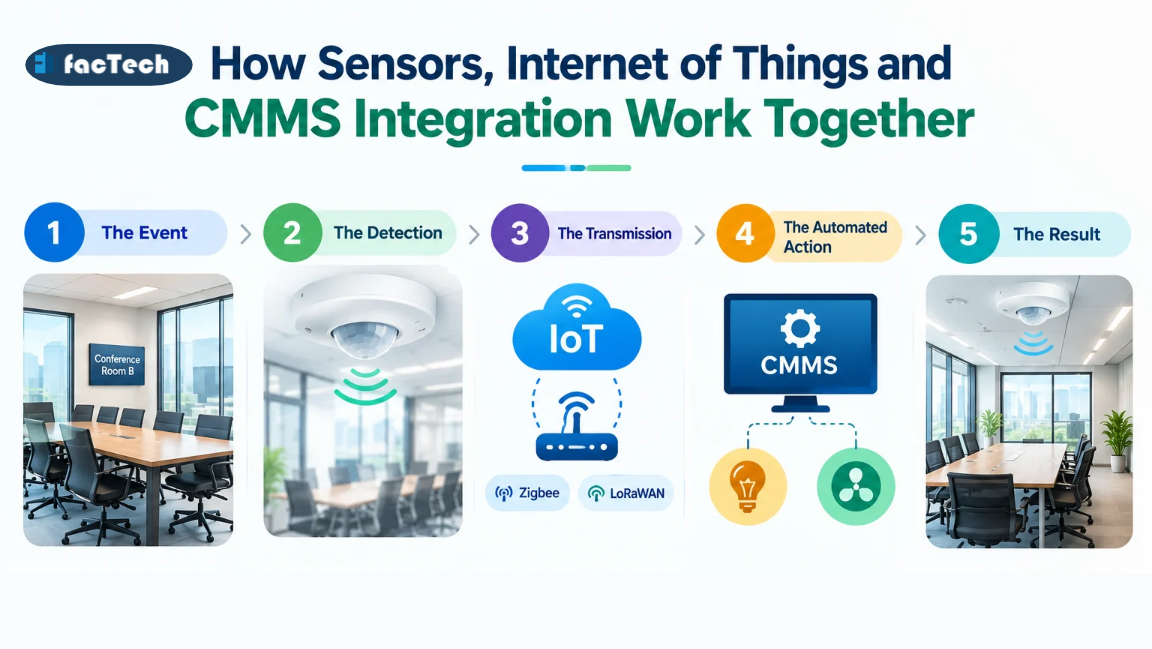
How Sensors Internet of Things and CMMS Integration Work Together
The real power comes from occupancy sensors internet of things networks and a CMMS working as one unified system
We will examine a real‑world scenario to see how this integration functions in an office building. This real‑world scenario shows the integration in action.
The Event: A team finishes an afternoon meeting in Conference Room B, at 3:00 PM. They leave the room empty in Conference Room B.
The Detection: Ten minutes after the room becomes still the ceiling‑mounted occupancy sensor notes no movement. The occupancy sensor declares the room vacant.
The Transmission: The sensor sends an occupancy status update using wireless IoT protocols, like Zigbee or LoRaWAN to the CMMS platform.
The Automated Action: The CMMS checks set business rules. It immediately tells the building management system to turn the lights off and to set the local HVAC variable air volume box into an energy‑saving setback mode.
The result: The result is that energy use in Conference Room B goes down, stopping a lot of electricity from being wasted. When the next meeting begins in the morning the sensor notices movement and brings back nice lighting and temperature levels all by itself before people even step inside the room.
Step-by-Step Implementation Guide for Facilities
Step-by-Step Implementation Guide for Facilities
To get the full ROI from an energy-saving solution using Sensors, IoT and CMMS Integration demands a disciplined implementation.
Step 1: Conduct an Energy and Space Audit
Before buying equipment examine building blueprints and utility bills. Energy and Space Audit tells you which areas use the energy—such as large conference rooms, cafeterias, hallways and private offices—where people move in and out a lot during the day.
Step 2: Install IoT- Occupancy Sensors
It is an idea to invest in IoT-Capable Occupancy Sensors that communicate through reliable IoT networks. IoT-Capable Occupancy Sensors are easier to install and cost less, than units. IoT-Capable Occupancy Sensors do not require you to cut through walls or run electrical cables.
Step 3: Connect Sensors to a Cloud-Based CMMS
Make sure your facility management software has API features so it can work well with your IoT hardware gateway. This way sensor data can flow directly into your maintenance dashboards and sensor data can stay visible on the maintenance dashboards without data entry.
Step 4: Program Automated Rules and Thresholds
Collaborate with your engineering team to create rules within the CMMS. For instance, set lights to turn off after fifteen minutes when the area is empty and set HVAC setbacks to start after thirty minutes of no movement, in work zones.
Step 5: Monitor, Analyze and Refine
Look at the reports that your CMMS creates every month. Check how kilowatt-hours you have saved. Watch how long the equipment is running. Make changes to the time that the sensors wait before turning off to get the results, between saving energy and keeping people comfortable.
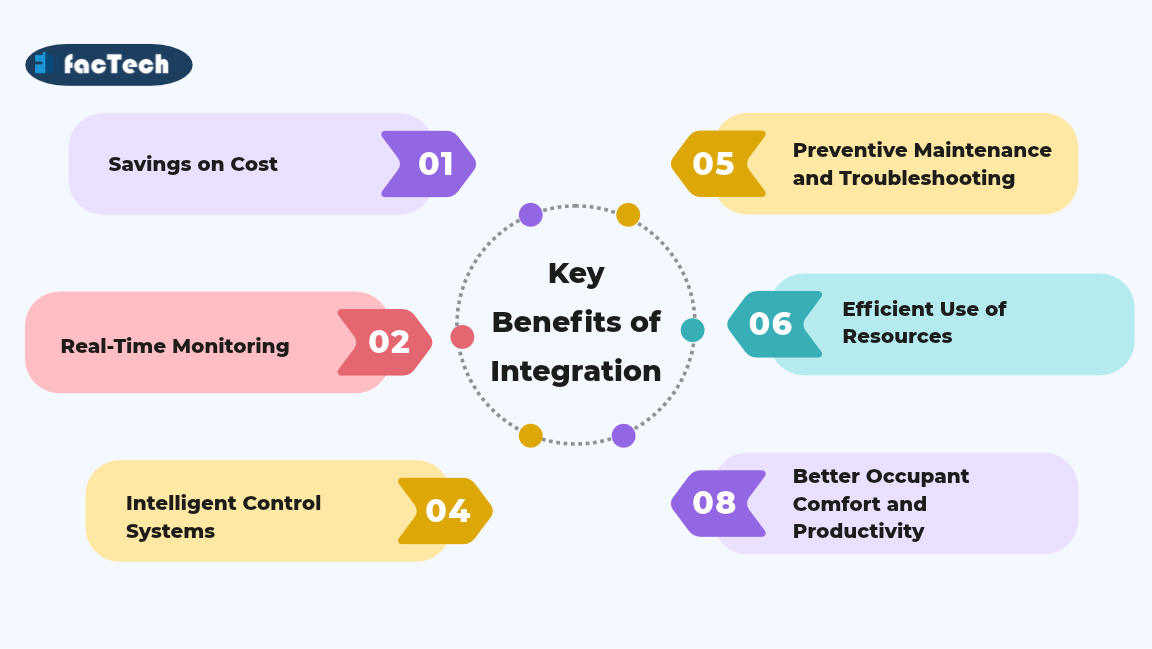
Key Benefits of Integrating Sensors, IoT, and CMMS
Savings on cost
Cost reduction is one of the biggest benefits of IoT in building management, as mentioned above. IoT devices can track and regulate several functions in a building, such as heating, cooling, lighting, even water usage. These gadgets capture data in real time and use this data to improve energy consumption.
Real time monitoring
The building sensors are the backbone of a building management system and allow for real time monitoring. The basis for demand-based control is their ability to gather and transfer critical data, for example, temperature sensors monitor room temperatures and the BMS can run heating and cooling systems more effectively
Intelligent control systems
An IoT based BMS allows effective control of lighting and HVAC systems. For example, smart lighting can adjust brightness based on natural light availability, occupancy, or time of day. Similarly, HVAC systems can be programmed to run only in inhabited spaces. These reasonable modifications lead to substantial energy savings while maintaining comfort.
Better occupant comfort and productivity
“The IoT benefits not just the building owners but also enhances the experience for the residents. Smart systems make the surroundings more comfortable and productive. Residents can also regulate their inside environment through smartphone apps, altering temperatures, lighting and other preferences to fit their needs.
Preventive maintenance and troubleshooting
Building Management Systems can identify and warn operators of any faults or inefficiencies in the building’s systems. For example, an IoT-BMS may determine when HVAC systems are not functioning optimally and so consuming excess energy. However, identifying these flaws early allows operators to fix them before they become larger problems, resulting in more energy waste.
Efficient use of resources
An IoT based BMS implementation gives the facility the information it needs to know how resources are being utilized. Facility managers can utilize energy use, occupancy and equipment performance data to make smart resource allocation choices. This lowers needless expenditure and boosts overall operating efficiency. It can track space utilisation patterns, so you can manage your office layouts and space assignments better.
Best Practices for Long-Term Success
To keep your energy system running smoothly for many years remember these operational best practices:
Regular Battery Checks: If your IoT occupancy sensors are battery-powered, schedule regular preventive maintenance work orders, in your CMMS so that batteries are replaced before they run out.
Calibrate Sensor Sensitivity: Check sensors in high-traffic areas on a basis to make sure they are not turning on lights or adjusting temperatures unnecessarily. Also confirm they are still picking up on occupants who are present.
Involve Building Occupants: Teach building users about how the automated system works. Let employees know why lights go off or why temperature settings change automatically. This helps build trust and supports a shared focus on saving energy.
Keep Firmware Updated: Firmware updates are essential. Updating firmware on your gateway and sensors protects your network from cyber security vulnerabilities.
The bottom line
Reducing electricity expenditures is more than just turning off lights when you leave the room; it’s a data-driven, coordinated approach. Organisations may use occupancy sensors, IoT connection and centralised CMMS to transform static buildings into smart, self-regulating environments. This powerful integration eliminates hidden energy waste, reduces monthly utility costs, improves the life of equipment, and advances critical environmental sustainability goals. Whether you are managing a corporate office park, an educational campus or an industrial complex, smart automation is a quick ROI and demonstrates that operational efficiency and environmental responsibility are two sides of the same coin.
FAQs
Q: How does IoT minimise energy usage?
IoT saves energy via smart meters and sensors. These gadgets give real-time energy usage statistics, allowing consumers to monitor and study their consumption trends. IoT provides extensive information to help customers to make informed decisions, uncover inefficient habits and optimize their energy use.
Q2: What role does a CMMS play in today’s energy management?
A Computerized Maintenance Management System (CMMS) is your brain. It ingests real-time IoT sensor data, interfaces with building automation systems, initiates automated energy-saving algorithms and generates maintenance work orders when equipment is running inefficiently.
Q3: What are the key benefits of integrating sensors, IoT and CMMS in a facility?
The key benefits are lower electricity costs, real-time energy monitoring, automated preventative maintenance, maximum indoor comfort for occupants, increased equipment life, and efficient use of space.
Q4: What are best practices for maintaining a smart energy management system?
Facilities should regularly replace batteries in sensors, adjust motion sensitivity in areas, keep sensor and gateway firmware updated to protect against cyber threats and teach building occupants how the automated energy setback rules work. Consistent maintenance leads to operation of the smart energy management system.
Ready to Transform Your Facility Management?
See how Factech automates maintenance, assets, and compliance in one intelligent platform.
Let's Talk
Have questions about our AI-powered solutions? Our team is here to help you digitize your facility operations.