Facilities management is an essential component in the process of developing workplaces that are not only safe but also efficient and productive. Facility managers are responsible for the maintenance, operation, and assurance of safety of buildings, as well as the provision of workplace services, in order to guarantee that facilities aid in the success of day-to-day operations and the performance of the firm. The roles and responsibilities of a facility manager include planning, maintenance, safety, and service provision, as well as the day-to-day operation of buildings to ensure that people are able to make efficient use of their time. To put it another way, the facilities manager is responsible for ensuring that the workplace contributes to the accomplishment of the company’s objectives rather than acting as a barrier to those objectives.
The purpose of this article is to discuss the numerous activities that are performed by the facilities manager, as well as the necessity of understanding these functions in order to improve their ability to coordinate with other departments within the organization.
What is a Facility Management Manager?
A facilities manager is responsible for overseeing the day-to-day operations of a single building or multiple facilities throughout an organization. Facility managers are the individuals who are accountable for the safety of the workforce, the layout of the office, the preventative maintenance of the building, the management of contractors, and the monitoring of health and safety compliance. FMs are able to assist with this task by utilizing technologies that are associated with computer-aided facilities management software.
The following three important areas are included in the day-to-day operations of a manager of facilities and maintenance:
Place: In good repair of the physical building grounds, structural integrity, utilities and emergency systems .
Process: Establishing operational routines, vendor contract management, and tracking maintenance schedules to save money.
Building management managers ensure that the efficiency of a firm is never negatively impacted by operational disruptions, regardless of whether the building in question is a corporate high-rise or a manufacturing factory.
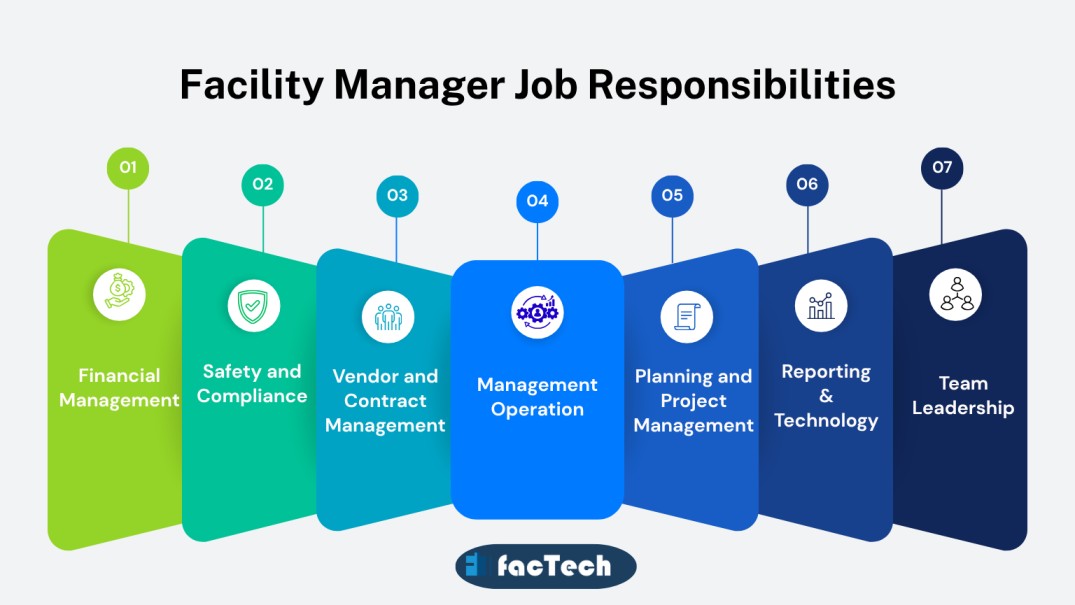
Facility Manager Job Responsibilities
When you have a comprehensive work description for a facilities manager, you are better able to comprehend the variety of the career. These are the primary responsibilities that fall under the purview of the facility manager:
Financial Management:
Managing the facility’s budget and providing advice to businesses on how to improve their efficiency and reduce their expenses are both responsibilities of this position.
Safety and Compliance:
Compliance with legal requirements, health and safety standards, and regulatory laws is one of the most important obligations that must be fulfilled by the institution. They want to make sure that employees and the facility are safe, including ensuring that fire protection systems and elevators are within compliance standards.
Vendor and Contract Management:
Additionally, they are responsible for the acquisition and management of contracts and service providers for essential services such as food, cleaning, parking, security, and technology.
Management Operation :
The day-to-day operations of the facility are under their responsibility, which includes performing preventative maintenance, responding to emergencies, and performing basic maintenance on the facilities. The scope of their tasks may encompass a wide range of offerings, ranging from cleaning services to gardening to the maintenance of malfunctioning equipment. As part of their efforts to ensure that the facility continues to function as it should, they perform daily inspections, repairs, and maintenance tasks.
Team Leadership:
In addition to managing teams of individuals in a variety of departments, facility managers are responsible for supervising the employees that are employed within the facility. They work in collaboration with staff members to create an atmosphere that is both joyful and productive.
Reporting & Technology:
They have the ability to generate maintenance reports and make use of technology, such as CMMS software, in order to boost efficiency and simplify day-to-day operations. provides a compilation of the essential documents and information for the administration of maintenance. Planning ahead.
Planning and Project Management:
Additionally, facility managers are responsible for planning for future building requirements and supervising construction projects such as renovations, refurbishments, and other construction endeavors. They are also able to assist with office relocations and assessments of the state of the facility.
Job Outlook for Facilities Management Manager
The need for facilities management manager positions is increasing across a variety of industries as a result of the increasing demands placed on corporations to meet increasingly stringent sustainability standards and the increasing sophistication of real estate settings.
Industry Sector
Primary Facility Focus
Key Manager Goal
Corporate Office
Flexible desk seating, employee comfort, and smart energy tools.
Optimizing floor space and productivity
Healthcare and Hospitality
Air filtration standards, hygiene protocols, and backup power systems.
Ensuring strict regulatory compliance
Manufacturing Plants
Heavy machine maintenance, industrial safety, and environmental compliance.
Preventing operational downtime
Education & University
Campus building safety, groundskeeping, and dormitory maintenance.
Supporting student welfare and safety
Fundamental Skills Required For Modern Facilities Management Manager
The following are examples of jobs that require managers to be proficient in both hands-on skills and technology literacy in order to be successful in today’s society:
Digital & Technical Skills
CAFM / IWMS Expertise: A practical experience with intelligent integrated solutions for facility management is required for the CAFM and IWMS expertise category.
Data & IoT Analytics: In the realm of data and internet of things analytics, the capability to understand building sensor data in order to reduce energy expenses.
Smart Building Technology: Smart building technology includes keyless security access, automated lighting controls, and smart controls for heating, ventilation, and air conditioning.
Compliance Tracking: Digital reporting solutions allow for the automatic maintenance of legal safety records, which is part of compliance tracking.
Operational and Soft Skills
Leadership & Team Management: Management of multi-disciplinary teams consisting of maintenance, cleaning, and security personnel was part of my leadership and team management responsibilities.
Vendor Negotiation: Contract negotiations with external service providers that are both cost-effective and efficient are referred to as vendor negotiations.
Crisis Management: Crisis management is the process of handling power outages, natural disasters, or structural problems in a calm and collected manner.
Financial Acumen: The ability to accurately budget for operational costs and calculate the return on investment (ROI) of assets can be considered financial acumen.
Regardless of the size of the company, effective administration of the facilities is critically vital.
Expert Knowledge: Bigger companies typically have their own facility manager. Outsourcing facility maintenance can be a more effective, cost-efficient solution for smaller organizations or those who lack in-house experience, allowing them to focus on their core business activities.
Driving to Save Money: They find ways to enhance efficiency or save money, which is beneficial for the bottom line of the company. Drivers are able to save money by driving.
Employee Wellbeing: Facility managers play a crucial part in ensuring that their workplaces are secure, well-functioning, and conducive to employee happiness and productivity.
Efficiency Assurance: One of the benefits of efficiency assurance is that it guaranties that business processes will run smoothly and efficiently, with minimal or no delays caused by technical faults. It is especially pertinent in light of the proliferation of smart buildings and other forms of advanced technology, both of which require efficient administration in order to remain uninterrupted.
How Facility Management Software Help Facility Manager
Advanced facility management software is essential for the future of facility management. Old school hand logs and spreadsheets are a dying breed. Today’s facility managers run entire buildings from a single screen using digital platforms.
This digital transformation is driven by AI and IoT sensors. Smart sensors constantly monitor temperature, humidity, occupancy of rooms and vibration of equipment. If a machine is wearing out, the software will immediately catch it. It automatically generates a maintenance work order before a breakdown. Moving to predictive maintenance saves firms hundreds of dollars in emergency repair costs.
And clever software helps facilities managers achieve critical environmental goals. Automated systems constantly monitor energy consumption, water use and carbon emissions. Managers can optimize lighting and heating schedules according to the daily use of the rooms. This reduces waste of utility, and decreases the total running expenses. know more about facility management tools used by facility manager.
In addition, dynamic space planning capabilities assist managers in effortlessly running modern hybrid work environments. Employees easily book desks, conference rooms and parking spaces on mobile apps. Facility management software brings together human operations and built-in automation to enable current day managers to make data-driven operational choices with ease.
The Bottom line
The role of the facilities manager is critical to the success of any company since it encompasses a wide range of responsibilities. Facility managers have the ability to create an environment that is safe, efficient, and productive for all inhabitants by first gaining a grasp of the essential activities, then going on to implement best practices, and finally making use of technology such as a CAFM/CMMS. A company’s facility manager is an extremely valuable asset to any company. The management of budgets and the supervision of maintenance, as well as the management of safety and the enhancement of operational efficiency. By using advanced technology a facility manager can become a digital facility manager and with his smartness he can help in growth and development.
FAQs
Q: Is a Facility Manager Required for Every Building?
On the contrary, yes. Having a facilities manager who is both knowledgeable and competent at the helm is beneficial for large companies like NHS Foundation Trusts and owners of enormous estates and several sites since it allows them to maximize their worth. On the other hand, with the assistance of solutions such as CAFM Software, facility managers can be replaced by other individuals in smaller businesses such as nurseries and office buildings that are rented out.
Q: What are the duties and obligations of facility management?
Safety, space planning, contractor control, services, compliance, and operation support are some of the roles and duties that are included, but are not limited to, these areas.
Q: Are facility managers in charge of safety and health?
Yes. Inspections, risk controls, emergency procedures, maintenance records, and compliance support are frequent responsibilities that they manage.
Q: What does a facilities manager do?
The most important duty is to make certain that the structures, services, equipment, and processes in the workplace are all functioning properly and contributing to the productivity of the company.
Q: What are the four most important skills an FM needs to have?
When looking for someone to run a building on a daily basis, keep these four traits in mind:
Strategically-minded: Find a balance between short-term FM goals and how well a building works in the long run.
Focused on People: Work well with both your own team and workers from outside the company.
A Solution-Finder: Be clear with leaders and employees about building issues and activities.
The analytical mind is able to understand and make connections between different types of data analytics in FM.
Factech Solutions digitizes and automates facility operations by connecting maintenance, assets, complaints, inspections, approvals, and service workflows in one platform. It reduces manual coordination, improves process tracking, and helps teams manage facility activities through structured, data-driven workflows.