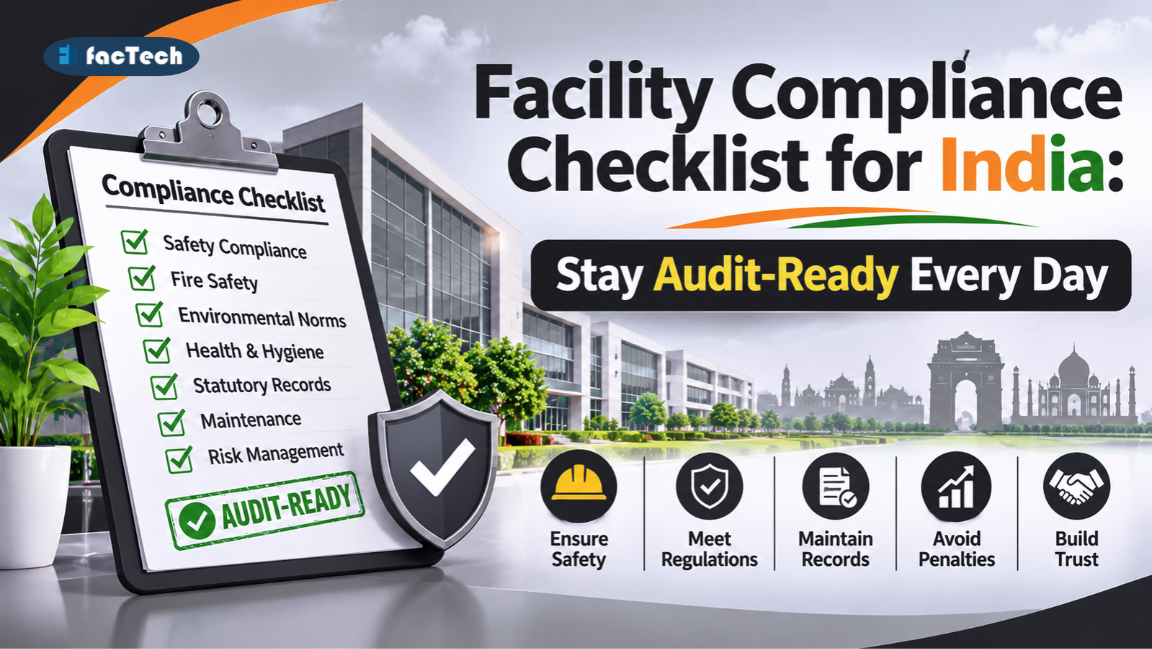
Facility Compliance Checklist for India: Stay Audit-Ready Every Day
It’s Thursday evening, and your building owner calls, an inspector is coming on Monday. Suddenly you’re hunting for the fire NOC, the lift licence expiry date and the last STP test report. Most facility teams don’t fail audits through carelessness. They fail because certificates, dates and owners are scattered. You can’t fix that in 72 hours, but you can make sure it never happens again. This facility compliance checklist for India, plus a simple tracking system, will help you stay ready any day.
Why the Compliance Scramble Happens
Most teams face the same four problems.
- Scattered Papers. Certificates sit in files, emails, WhatsApp chats and personal laptops.
- No Single Owner. Everyone thinks someone else is watching the dates.
- Hidden Expiry Dates. A certificate is valid for one year, and the renewal date is remembered only by the person who left last month.
- Missing Proof. The work was done, but there is no report, photo or signed sheet to show it.
The result is panic before every audit. Fines, notices, a failed inspection or an insurance problem can follow. In the worst case, a safety failure puts people at risk.
The fix is not working harder before the audit. The fix is a system that keeps you ready every day.
Facility Compliance Checklist for India: Statutory Items to Track
Rules differ by state, city, and building type, so always confirm the exact list with your legal or operations team. Here are the items most Indian facility teams track.
Fire Safety
- Fire NOC or fire safety certificate, and its renewal
- Fire extinguisher refilling and testing dates
- Hydrant, sprinkler and fire alarm system checks
- Fire drill records and staff training logs
Lifts and Escalators
- Lift licence and annual inspection
- Maintenance contract and service reports
- Inspection reports from the competent authority
DG Sets (diesel generators)
- Consent or permission from the State Pollution Control Board, where required
- Emission and noise test reports
- Fuel logs and service records
- Electrical inspector approval, where applicable
STP (sewage treatment plant)
- Consent to operate from the pollution control board
- Treated water test reports (lab reports, usually monthly or quarterly)
- Daily operation logs and sludge disposal records
Licences and Other Approvals
- Trade licence and building occupancy certificate
- Electrical safety audit and earthing test reports
- Water quality tests
- Pest control records
- Insurance policies
- Contractor licences and labour records
Treat this list as your base statutory compliance tracker for buildings. Add or remove items to match your site.
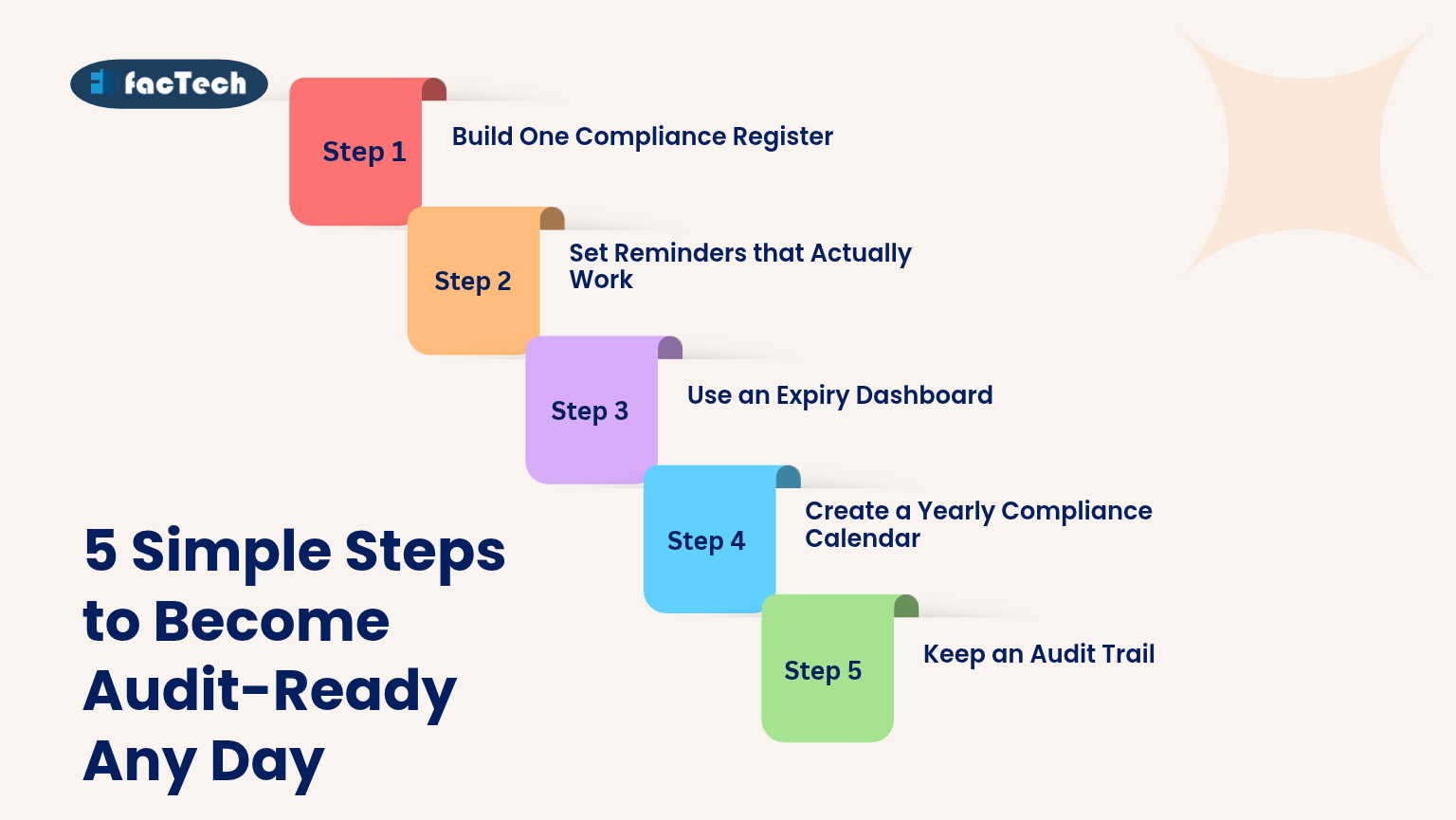
5 Simple Steps to Become Audit-Ready Any Day
Step 1: Build One Compliance Register
The first step is simple: put everything in one place. One register, one source of truth.
For every item, record these fields:
| Field | Example |
| Compliance item | Fire NOC |
| Applicable authority | State Fire Department |
| Certificate or licence number | (as printed) |
| Issue date | 12 Jan 2026 |
| Expiry date | 11 Jan 2027 |
| Renewal lead time | 60 days |
| Owner (person responsible) | Site manager |
| Document link | Scanned copy or file |
| Status | Valid / Due soon / Expired |
Two small tips make a big difference:
- Write the renewal lead time.
- Name one owner for each item.
You can start with a spreadsheet. If you manage many sites or hundreds of items, move to CAFM software (computer-aided facility management), as explained below.
Step 2: Set Reminders that Actually Work
A register is only useful if it tells you something before it is too late. Set alerts in layers:
- 90 days before expiry: start gathering documents and quotes
- 60 days before: submit the renewal application
- 30 days before: follow up with the authority or vendor
- 7 days before: escalate to the manager if still pending
Send each alert to two people, the owner and their manager. If the owner is on leave, the backup still sees it.
Also set reminders for repeat inspections, not only certificates. Fire extinguisher checks, STP lab tests and lift servicing happen on a regular cycle. These are easy to forget because there is no single big expiry date.
Step 3: Use an Expiry Dashboard
A dashboard turns your register into a picture you can read in seconds. A good one shows:
- Green: valid for more than 90 days
- Yellow: expiring within 90 days
- Red: expired or overdue
- Count by category: how many fire, lift, DG, STP and licence items are at risk
Review it in a short weekly meeting. Ten minutes is enough. Ask three questions:
- What is turning yellow this month?
- What is red, and why?
- Who needs help to close it?
This habit alone prevents most last-minute surprises.
Step 4: Create a Yearly Compliance Calendar
A compliance calendar lays out the whole year on one page. It shows which inspections, tests and renewals fall in which month, so you can spread the workload and avoid a month where five things are due together.
Share the calendar with your vendors, security team and building management. Download or print the calendar you created, and keep a copy at the site office. Update it whenever a new rule or contract comes in.
Step 5: Keep an Audit Trail
Auditors do not only ask “Do you have the certificate?” They also ask “Can you prove the work was done?” This is where many teams struggle. Keep a simple audit trail checklist for every compliance item:
- Valid certificate or licence copy
- Inspection or test report with date and signature
- Work order or service ticket
- Before and after photos, where useful
- Name of the person or vendor who did the work
- Corrective action taken for any issue found
- Date and name of who closed the issue
- Payment or contract proof for the vendor, if relevant
When every task leaves a record, you can answer an auditor in minutes, not days.
Where CAFM Software Helps
A spreadsheet works for a small site, but it has limits. Someone must update it. Reminders depend on someone remembering to check. Files live in different folders. Version confusion creeps in.
CAFM software (computer-aided facility management) solves these problems by keeping everything together:
- One register for all sites, assets and licences
- Automatic expiry alerts by email or SMS
- Live dashboards showing what is valid, due and overdue
- Scheduled inspections that create tasks on their own
- Document storage attached to each asset or certificate
- Audit history showing who did what and when
- Reports you can download at the click of a button
The result is that a request like “show me all fire and lift documents for Tower B” takes a minute instead of a day.
A Simple 30-day Plan to Get Started
You do not need to fix everything at once. Try this:
Week 1: List. Collect every certificate, licence and inspection report you have. Note what is missing.
Week 2: Register. Enter all items in one sheet or in your CAFM. Add expiry dates, owners and lead times.
Week 3: Alerts and calendar. Set up reminders and build your yearly compliance calendar.
Week 4: Review. Run your first dashboard meeting. Close the red items. Plan the yellow ones.
After 30 days, you will know exactly where you stand. That alone puts you ahead of many teams.

Common Mistakes to Avoid
- Waiting for the last week. Renewals take time. Start early.
- Trusting memory. People change jobs. Systems do not.
- Storing only the certificate. Keep the supporting reports as well.
- Ignoring vendor documents. Contractor licences and insurance also count.
- Never test your readiness. Do a mock audit twice a year. Pick a random item and see how fast you can show the proof.
The Bottom Line
Being audit-ready is not about luck or last-minute effort. It comes from a few steady habits: one register, clear owners, early reminders, a visible dashboard, a yearly calendar and a proper audit trail. Use the facility compliance checklist for India items above, adjust them for your state and building, and confirm the list with your operations or legal team.
Start small this week. Put your fire, lift, DG, STP and licence dates in one place. The next time someone says an inspector is coming, you can simply say, “We are ready.”
CAFM software is very helpful in these preparations, maintaining records and providing real-time results for multiple buildings, assets and equipment. “See how CAFM software keeps your compliance records audit-ready. Book a free demo.”
Frequently Asked Questions (FAQs)
- What is a facility compliance checklist?
It is a list of all the legal and safety requirements a building must meet, such as fire NOC, lift licence, DG set permissions, STP reports and trade licences. It also records dates, owners and proof of work for each item. - Which statutory compliances do Indian buildings usually need?
Common ones include fire safety certificate, lift licence and inspection, pollution control board permissions for DG sets and STPs, electrical safety audits, trade licence and insurance. The exact list changes by state, city and building type, so confirm it with your local authority or legal team. - How early should I start renewing a certificate?
Start 60 to 90 days before expiry. Some approvals take weeks because of inspections, documents and follow-ups. Starting early gives you a safety buffer. - Can I track compliance in Excel, or do I need CAFM software?
Excel works for one small site with few items. If you have multiple sites, many assets or a large team, CAFM software is better. It sends automatic alerts, stores documents and keeps an audit history without manual updates. - What records should I keep to be audit-ready?
Keep the valid certificate, inspection or test reports, service tickets, signed checklists, photos where useful, vendor details and proof that any issue was fixed. Make sure each record shows a date and the name of the person responsible.
Ready to Transform Your Facility Management?
See how Factech automates maintenance, assets, and compliance in one intelligent platform.
Let's Talk
Have questions about our AI-powered solutions? Our team is here to help you digitize your facility operations.