LT Panel Maintenance – Why & How?
What is the Full Form of LT Panel?
LT Panel stands for Low Tension Panel. It is an electrical distribution panel used to control, monitor, and distribute low-voltage power supply, generally up to 415V or 440V. LT Panels are widely used in industries, commercial buildings, hospitals, factories, and residential complexes for safe and efficient power management.
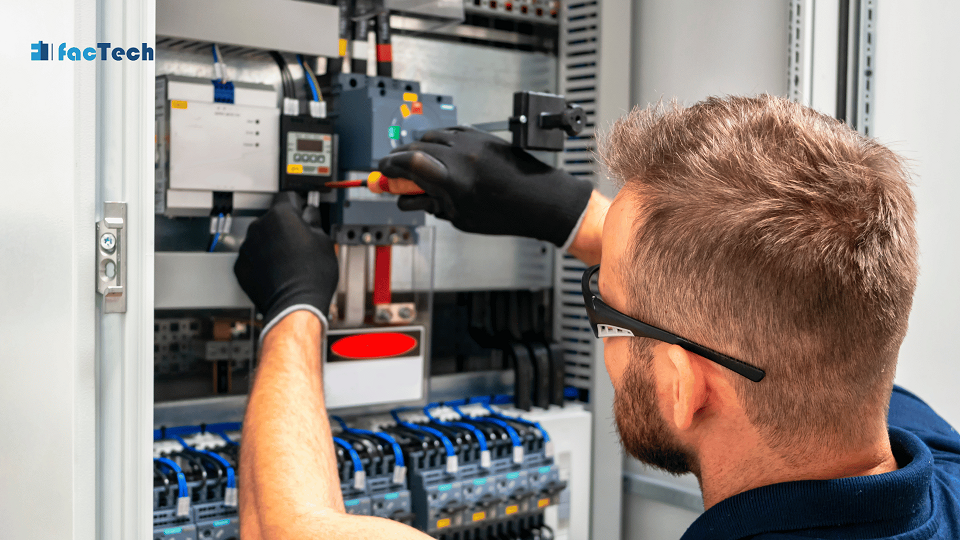
These panels contain components such as circuit breakers, MCCBs, relays, busbars, switches, and protective devices that help prevent electrical faults, overloads, and short circuits. LT Panels play a crucial role in maintaining electrical safety, reducing downtime, and ensuring smooth power distribution. Different types of LT Panels, including PCC Panels, MCC Panels, and APFC Panels, are designed to meet specific industrial and commercial power requirements.
What is Low Tension (LT) Panel
LT Panel is an electrical distribution board that receives power from generator or transformer and distributes the same to various electronic devices and distribution boards.
What is use of LT Panel
LT Panels are used with low tension cables to obtain power from the generator or transformer and distribute electricity to various electrical devices and distribution boards. LT panels are designed to function at lower voltages (up to 690 Volts) with low insulation levels.
LT Panel Maintenance Procedure
- Put OFF the supply where you want to carry out the work.
- Provide a board “Men at work do not switch on”.
- Remove the fuses if required use fuses puller.
- Ensure you are standing on an insulating rubber mat.
- Use foot ware while doing the work.
- Have proper tools like insulated plier, test lamp, tester, wire stripper, and fuse puller.
- Ensure conductor is dead before handling it.
- Carry out the maintenance.
- Before charging the supply, ensure that no tools are left inside the panel.
- Close the doors of the panel.
- Leave the workplace only after satisfactory trial.
- Frequency for preventive maintenance of the low tension panel is once in a six month.
Operation for Closing Air Circuit Breaker
- Ensure breaker in proper position inside the panel.
- Ensure that “TRIP CIRCUIT HEALTHY” indication appears on the panel.
- Check incoming voltage between R–Y, Y-B and B-R on the volt meter provided, it should be 415 to 430 volts wherever applicable.
- Charge the closing circuit breaker by the to and fro movement of the handle provided on the breaker.
- Repeat the step 4 until the spring indicator on breaker show charged.
- Ensure the spring indicator on breaker show spring charged.
- Push the green close button to close the circuit of the breaker.
- In case of Auto mode breaker will be continuously charged.
Operation for Opening Air Circuit Breaker
- Push the Red open button to open the air circuit.
Operation for Closing Main Feeder Circuit
- Rotate the feeder handle in the clockwise direction from 0 to 1 position.
- Ensure red color indicator will be “ON”.
Operation for Opening Main Feeder Circuit
- Rotate the feeder handle in the Anti clockwise direction from 1 to 0 positions.
- Ensure red color indicator will be “OFF”.
LT Panel Checklist
For the safety and dependability of your facility’s power distribution, a detailed and methodical checklist for the LT (Low Tension) Panel is required. Standard panels work for smaller loads . LT panels are the heart of a building’s electrical system and need additional technical inspection .
Here is the detailed checklist for LT Panel Inspection:
1. Inspect Enclosure and Physical Structure
Check the exterior of the panel for any physical damage, dents or rust. Check that all door hinges work freely, and that gaskets are in good repair, to keep dust and vermin out. Make that the “Danger” signs and voltage ratings are legible on the front of the panel.
2. Check Busbar and Insulator
Look at the busbars for discoloration or pitting. This is generally a sign of overheating. Check busbar insulators for fractures or carbon tracking. Bus bars carry large currents and it is crucial to maintain their physical integrity to avoid catastrophic phase-to-phase shorts.
3. Verifying the Tightness of the Connection
Insulate all tools used to check the tightness of all cable terminations and busbar bolts. “Hot Spots” in LT panels are mostly due to loose connections. Regular tightening avoids arcing and reduces risk of electrical fire caused by high resistance connections.
4. Operation of Switchgear and Circuit Breakers
Manually test the ON/OFF and Trip mechanisms of ACBs and MCCBs. Make sure that the racking mechanism of draw-out breakers is properly greased and operating properly. This assures the system will respond immediately during a real fault.
5. Metering and Indicator Precision
Check that all analog and digital meters (Voltmeter, Ammeter, Energy Meter) are showing correct values. Make sure all phase indication lamps (R-Y-B) and status indicators (Service/Test/Trip) are working. Bad indications can result in dangerous misinterpretations of whether or not the panel is powered.
6. Testing of Protection Relays
Earth Fault, Overcurrent and Short Circuit protection relays testing. Make sure that the relay settings are in accordance with the original design standards. If a relay does not trip on an overload, it can cause complete system failure, or damage to equipment.
7. Megger (Insulation Resistance) Testing
Conduct a Megger test to measure the insulation resistance between phases and phase to earth. Low resistance readings mean that the insulation is breaking down and current could leak or short circuit. Maintain a historical log of these values to predict when insulation may fail.
8. Integrity of Earthing System
Check the link between the panel body and the main earthpit. Make sure earth resistance is below safe limits (often under 2 ohms). Proper grounding is crucial for worker safety and the proper operation of surge protection systems.
9. Thermal Imaging (Infrared Scan)
Run a thermographic scan with the panel loaded up. This non-invasive test detects “hot spots” not visible to the human eye. Early detection of these temperature spikes can help prevent maintenance before a component fails.
10. Dusting and Cleaning
Use a vacuum cleaner or low-pressure air blower to clean up any dust that has formed on the switchgear and insulators. Never use a damp cloth. Dust can conduct in very humid conditions, “flashovers” over insulators can occur.
11. Check of Control Wiring and Ferrule
Check small-gauge control wiring for brittleness or rat damage. Make sure all cables have clear, legible ferrules (tags) to make troubleshooting easy. Neat and labeled control wiring greatly decreases downtime during emergency repairs.
12. Cooling and Ventilation System
Make sure that the panel cooling fans rotate freely and that the air filters are not blocked. Proper circulation is critical to remove the heat created by strong electrical loads, especially in high-density LT panels.
13. Contact Resistance Measurements
Measure the contact resistance across breaker poles . High resistance at the contact sites causes localised heating and can damage the breaker’s internal components over time.
14. Safety Clearances and Accessibility
Clear working space at least 1 meter in front of the panel. Check that the insulating rubber pad in front of the panel is in excellent condition and rated for the correct voltage. Storage or debris must never block clearances.
Difference Between HT and LT Panel
The fundamental distinction between HT (High Tension) and LT (Low Tension) panels is their voltage levels and their function within an electrical network. HT panels are constructed for high voltage power, commonly from 11kV to 33kV. These panels are put at the point of electricity entry into a facility from the main grid. Their major purpose is to take this high voltage power and securely send it to a transformer, which reduces the voltage down to a more useful level for common use.
On the other hand, LT panels are the heart of a building’s internal power distribution. They control low voltage electricity , commonly 415V for three phase or 230V for single phase. The transformer then steps down the voltage and the LT panel then distributes the energy to lighting systems, machines, office equipment and other building functions. While HT panels are made for high power transmission and grid protection, LT panels are made to securely distribute that power to the end user and safeguard individual circuits from overloads.
FAQs
1. What is the full form of LT in electrical?
LT stands for Low Tension in electrical systems. It refers to voltage levels below 1000V used for power distribution in homes, offices, commercial buildings, and industrial facilities.
2. What is an LT switch?
An LT switch is a low-voltage switching device used to control electrical circuits, ensure safety, and manage power supply in residential, commercial, and industrial electrical systems.
3. What is an LT cable?
LT cable is a low-tension electrical cable designed for carrying electricity at low voltage levels between transformers, LT panels, machines, and electrical distribution systems safely.
4. What is the meaning of LT connection?
An LT connection is a low-voltage electricity supply connection provided to residential, commercial, and small industrial consumers for regular power usage and electrical operations.
5. What is an LT line?
An LT line is a low-tension electrical distribution line that transfers electricity from distribution transformers directly to homes, offices, factories, and commercial establishments.
6. What is the main function of an electrical LT panel?
The primary function of an electrical LT panel is to distribute electricity, monitor electrical flow, protect systems from faults, and improve overall power management efficiency.
7. What is an LT consumer in electricity?
An LT consumer is a person, business, or organization receiving electricity at low voltage levels for domestic, commercial, institutional, or small-scale industrial purposes.
8. What is the difference between LT and HT connection?
LT connections are suitable for low power consumption requirements, while HT connections are used in large industries and facilities requiring high voltage and heavy electrical loads.
9. What is an LT control panel?
An LT control panel is used to control, monitor, and protect low-voltage electrical systems, motors, generators, and industrial machinery from electrical failures and operational issues.
Factech provides Digital Facility Management Software where you can maintain and upkeep assets like LT Panel. Click here to contact.
References:
https://www.pharmaguideline.com/2008/02/sop-for-procedure-for-operation-and.html
http://www.pvjpower.in/lt-panel
Ready to Transform Your Facility Management?
See how Factech automates maintenance, assets, and compliance in one intelligent platform.
Let's Talk
Have questions about our AI-powered solutions? Our team is here to help you digitize your facility operations.