How Smart CAFM Prepares Your Buildings for IFRS & ISSB Compliance
Running a business comes with many rules. If you own properties or manage large facilities, you already know keeping track of every operation, maintenance, and asset is very important. Now there is some guidance that should be followed, and different reports are prepared by the business from time to time. These reports show how your business affects the earth. If your business operates globally or works with international investors, you will have to share data according to these rules. For ensuring that your company is following the IFRS(International Financial Reporting Standards) and ISSB (International Sustainability Standard Board) guidelines.
For property owners or facility managers this might sound like extra work. This work also takes time if you are still relying on the traditional facility management process. Now the question is can you solve the issue? The easiest answer is using technology. Achieving IFRs and ISSB compliance in the CAFM system changes everything. A smart software platform can collect your environmental data automatically during daily operations, making international reporting simple and accurate.
Let’s look at what these global standards mean for your business and how a modern CAFM software solves the problem.
What Every Businessman Needs to Know About IFRS & ISSB
As a business owner or property leader, you don’t need to become a scientist to understand these frameworks. You just need to know how they affect your corporate reporting.
The ISSB issued two major rules:
IFRS S1: This requires businesses to disclose any sustainability-related risks that could affect their financial future.
IFRS S2: This focuses specifically on climate-related data, such as your greenhouse gas emissions and energy consumption.
Why Businesses Need to Prepare ISSB Reports
The International Sustainability Standards Board (ISSB) reports are a must for companies across the globe. Here are 6 simple reasons why firms need to prepare them:
For Attracting Investors: These reports are checked by modern investors and banks before investing money. Good reports show your firm is a safe long-term investment.
Following the Law: ISSB laws are being increasingly adopted by governments globally. Now is the time to get ready to keep your business legitimate and avoid big fines.
To Save Money on Energy: Monitoring your temperature data reveals exactly where your buildings are leaking power and water, so you can save on your energy expenses.
To stay competitive on a global scale: Buyers around the world like to deal with sustainable partners. If you don’t have these reports, you could lose international customers.
Build a good reputation: When you share transparent data, you demonstrate to the public, your customers, and your staff that you truly care about the earth.
To Get Ready for Future Threats: These assessments help you anticipate future climate threats—like supply chain interruptions or resource shortages—before they hit your bottom line.
Problems Faced by Businesses in Preparing ISSB Reports
While these reports are highly valuable, creating them is not easy. Here are 6 main challenges that businesses face today:
Messy Data Living in Silos
Sustainability data does not sit in one clean place. Energy bills are stuck with the accounts team, waste receipts are kept on paper by housekeeping, and water logs are written in notebooks by technicians. Chasing down this scattered data across different departments and buildings creates a massive headache for managers every single year.
High Risk of Human Mistakes
Most companies are still collecting data on spreadsheets manually, and mistakes are often happening. An employee can easily misread a utility meter or enter the inaccurate number into an Excel sheet. One error, and your business sustainability report is wrong and unreliable under tough ISSB requirements.
Complex Carbon Math
Computing greenhouse gas emissions is very complicated for an average corporate team. You cannot simply state how much fuel or power you used, you have to convert those quantities into carbon dioxide equivalents ($CO_2e$) using sophisticated scientific procedures. Most companies don’t have the in-house ability to get this technical math right.
Strict “Audit-Ready” Requirements
International boards don’t want to just see your end sustainability figures, they want to “show your work.” This means that there must be a clear, reliable paper trail for every data point. “If a government auditor asks you where an energy figure came from and you cannot prove it then your business has serious compliance issues.
Large Workload and Expensive
Collecting data, making computations, and writing these huge reports, takes weeks of laborious effort. This throws a hefty administrative load on your current team and distracts them from day-to-day work. Many organizations end up paying a lot of money to outside consultants merely to get the report done.
Handling Multiple Building Portfolios
This difficulty is compounded for property owners that have multiple buildings throughout numerous cities. Each site is different, has different technology, and tracks data differently. Without a single, unified digital system, it feels almost impossible to standardize and combine all this multi-site data into one worldwide corporate report.

Kaizen ESG by Factech: Simplify Business Sustainability Reporting
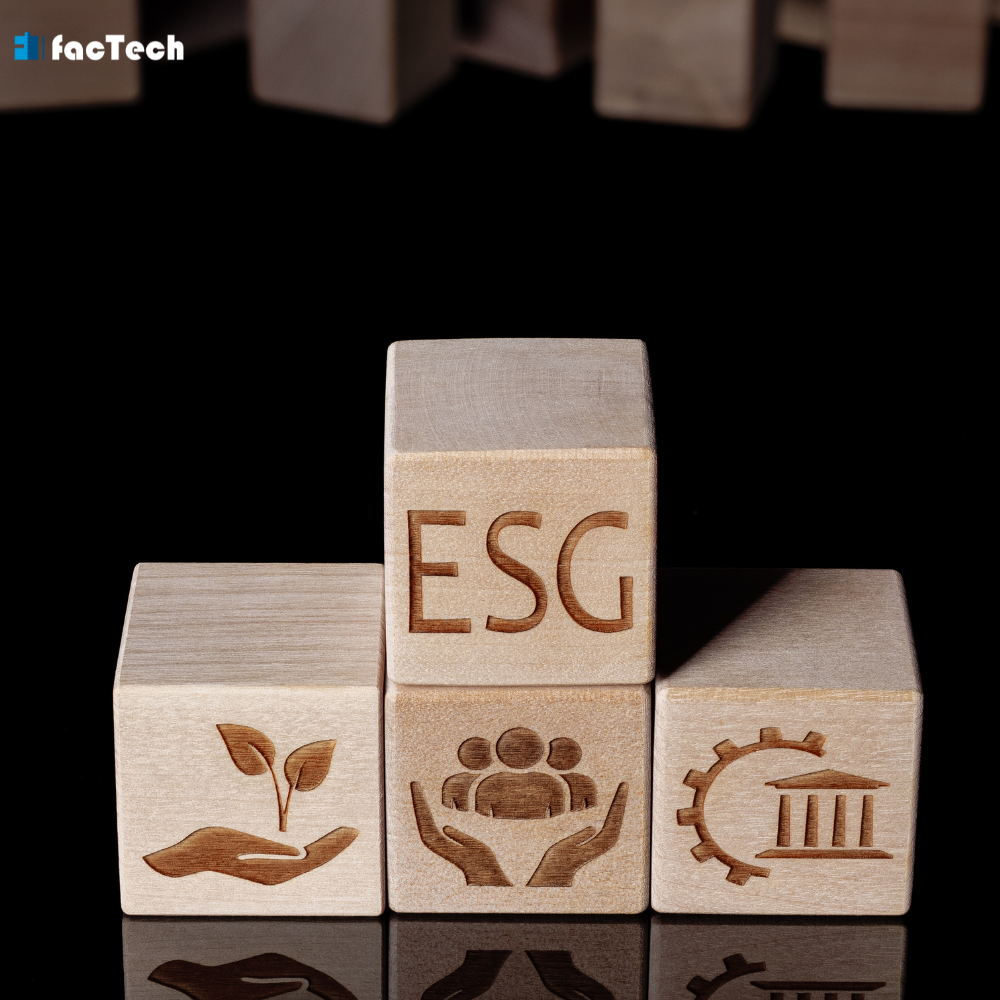
Many firms see ESG (Environmental, Social, and Governance) compliance as a difficult annual duty. The traditional way to do this is to sift through spreadsheets, find the dirty data, deliver it to pricey consultants, and generate a one-time PDF that is soon forgotten.
Kaizen ESG by Factech revolutionizes this process. Kaizen ESG views sustainability as a continuous cycle, not a one-time report. Since the program is designed directly on top of Factech’s Kaizen CAFM system, it seamlessly translates the everyday operational data your buildings currently generate into assurance-ready compliance reports.
Here’s exactly how Factech’s ESG software supports firms in creating seamless audit-ready sustainability reports:
Centralized Data Management
Sustainability data is generally kept in spreadsheets or dispersed among systems. ESG software unifies financial, operational & emissions data into one source of truth. This allows for more consistent and scalable reporting across business divisions and geographies.
Audit-ready Traceability
With growing regulatory and investor scrutiny, the ability to trace the source and process behind every data piece is important. ESG tools provide auditability through version control, data lineage, and documentation.
Real-time Insight and Benchmarking
Track progress over time and benchmark against industry. The software lets you see how you are doing in terms of aims such as reducing emissions or being more climate resilient and indicate where you can make improvements.
Embedded Alignment to Standards
Built to meet IFRS S1, IFRS S2, TCFD, and SASB requirements, the leading platforms also support the Global Reporting Initiative (GRI) and European Sustainability Reporting Standards (ESRS). With pre-set frameworks, you have the structure of disclosures right from day one, cutting down on manual work and compliance risk.
Scenario Analysis and Projection
Advanced platforms may simulate scenarios to determine your exposure to climate risk and test your resilience under a variety of future events–a must-have for IFRS S2 compliance.
The bottom line
The global trend toward sustainability reporting is here to stay. Originally a voluntary standard for big companies, it swiftly evolves into a necessary rule for firms of every size. Old-fashioned spreadsheets and paper records are simply not where a contemporary enterprise can afford to be.
Smart software solutions can give business owners and property managers complete control over their building operations. You move from crazy last-minute data hunting to a smooth, systematic, and proactive manner of working.
Compliance with IFRS and ISSB in CAFM systems: Beyond keeping your firm lawful. It gives you the precise, transparent data you need to attract international investors, cut your daily operational costs, and keep your real estate portfolio profitable and future-ready for decades to come.
FAQs
Q: What are the IFRS and ISSB standards?
The ISSB is an independent standard-setting body of the IFRS Foundation. The IFRS Sustainability Disclosure Standards are intended to improve the interaction between companies and investors so that investors have access to globally comparable, decision-useful sustainability-related disclosures that meet their information needs.
Q: What is IFRS S1 & S2 Compliance Readiness?
IFRS S1: describes how a corporation develops and presents its sustainability-related financial reporting. IFRS S2: includes climate-specific additional standards for climate-related risks and opportunities.
Q: Why are traditional spreadsheets not enough for ISSB reporting?
Manual typing is the basis of spreadsheets, therefore it’s quite easy for workers to mistype or mistakenly remove logs. International boards also want an “audit trail,” which means you have to show where every number comes from. Spreadsheets aren’t a good way to track or establish the data source, therefore your organization is vulnerable during an official audit.
Q: How does Kaizen ESG by Factech collect sustainability data without extra work?
It connects directly to the building operations you are already running. Because it is built right on top of the Kaizen CAFM system, it automatically captures data from daily tasks, maintenance records, and digital meter readings as they happen. You do not need to do any double data entry.
Q: What does “assurance-ready” data mean for a business owner?
“Assurance-ready” data is so clean, clear, and well-documented that an official government or financial auditor can verify it promptly without uncovering flaws. Every energy reading and every waste log is digitally time-stamped and signed with a user name, ensuring your annual audit is stress-free.
Ready to Transform Your Facility Management?
See how Factech automates maintenance, assets, and compliance in one intelligent platform.
Let's Talk
Have questions about our AI-powered solutions? Our team is here to help you digitize your facility operations.