
How AI in CMMS Helping Facility Teams
Contents
AI in CMMS changed the way of maintaining facilities in 2026. As we know, maintenance is the key to facility management. But in this digitally changing environment, relying on traditional methods will make it difficult to survive. To stay efficient and competitive, you need to implement the AI in CMMS software. AI gives a boost to the maintenance process by providing real-time data and proactive decision-making, which reduces the downtime and the operational cost. AI helps in making a building smarter, safer, and more efficient.
We’ll explain in this article how AI is changing maintenance from a “necessary expense” to a strategic ROI driver, giving teams the tools they need to work smarter, not harder.
AI in CMMS Software
It can be hard for maintenance departments to deal with equipment downtime, unexpected costs, and the need to keep everything working smoothly all the time. Traditional CMMS solutions can help you keep track of work orders, plan jobs, and save information about your equipment. However, they don’t have the predictive power that AI has.
AI-based CMMS software changes the game by adding predictive maintenance (PdM). The software uses machine learning to look at data from IoT sensors that keep a watch on vibration, heat, and sound. It finds small problems that people can’t see.

Real-World Challenges and AI Solutions
Here are some real-life examples of how AI-driven maintenance is changing several industries. None of these instances are direct competitors to CMMS; instead, they highlight how AI may help in many different situations.
Healthcare: Making Sure Life Support Works All the Time
The Problem: A power outage or broken MRI equipment in a hospital isn’t just an annoyance; it’s a life-threatening situation. Traditional maintenance regimens don’t always take into account how worn out interior parts are.
The AI Solution: AI-driven CMMS works with the hospital’s infrastructure to keep an eye on power loads and the health of medical equipment. It can tell when something is going to break before it does, which lets professionals do maintenance during times when there aren’t many patients, making sure that systems that are crucial to life never go down.
Manufacturing: Eliminating the “Ghost in the Machine”
The Problem: Manufacturers typically have to deal with “micro-stops,” which are tiny, regular stops in production lines that don’t look like big breakdowns but ruin daily output goals and return on investment.
The AI Solution: AI looks at high-frequency data from the production line to figure out what is causing these micro-stops (such as a belt that isn’t quite straight). The CMMS software then automatically creates a repair work order, turning “invisible” losses into measurable uptime.
Smart Buildings: Fixing the Energy Drain
The Problem: Large commercial buildings sometimes spend thousands of dollars heating or cooling unoccupied floors because their HVAC schedules are inflexible and “dumb” and don’t take into account how many people are really there.
The AI Solution: AI agents work with sensors that tell them how many people are in a room and weather forecasts. The CMMS automatically changes the climatic settings when a meeting room is empty or a floor is only 20% full. This cuts energy expenditures by 15% to 22% right away, without anyone having to do anything.
Logistics and Warehousing: How to Handle “Wrench Time” in Huge Buildings
The Problem: Technicians spend more time getting from the office to the asset than fixing things in warehouses that are millions of square feet, which wastes a lot of time and money.
The AI Solution: AI uses “Smart Dispatching” to organize work orders by where they are and how close the technician is to them. Kaizen’s mobile-first interface lets technicians see all of their nearby assignments on their phones. This cuts down on travel time and increases “wrench time” by up to 30%.
Education and Retail: How to Stay Audit-Ready Without the Stress
The Problem: Schools and retail chains have a lot of paperwork to do to stay up with health audits, fire safety, and elevator certifications. If you miss a deadline, you could face big fines or even have to close.
The AI Solution: The AI-Based CMMS is like a “Compliance Guard.” It doesn’t simply remind you of a deadline; it also makes the inspection checklist, saves the digital proof (pictures and signatures), and puts it in a cloud-based audit trail that you can retrieve with one click during a surprise inspection.
The Main Benefits of AI in CMMS Software
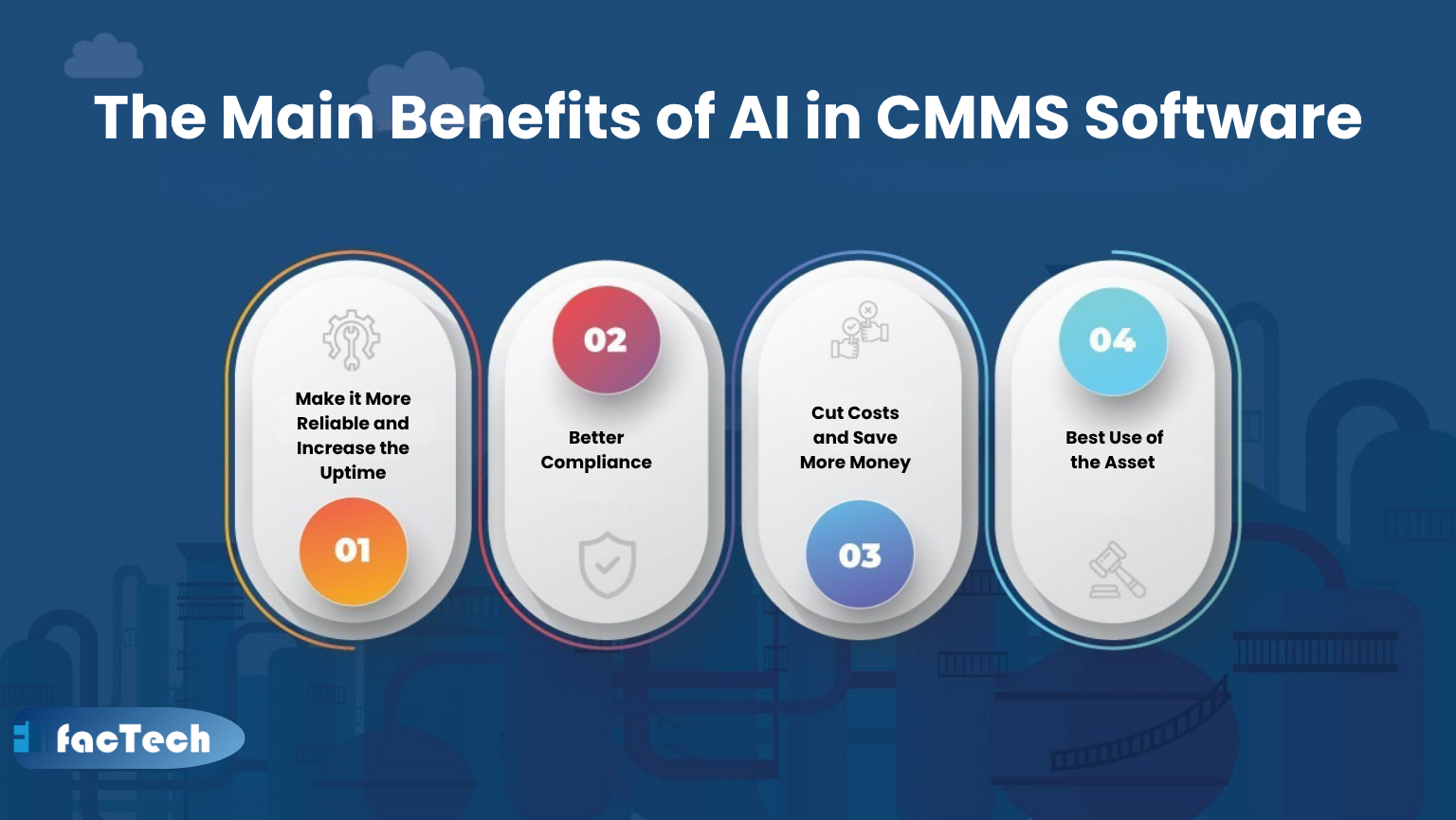
Best Use of the Asset
When you don’t take care of your equipment, it tends to break down more quickly. CMMS AI software ensures you don’t miss crucial maintenance times or utilize equipment until it breaks. Over time, this level of maintenance can add years to the life of an asset.
Make it More Reliable and Increase the Uptime
Reducing downtime has a direct impact on the bottom line. Using AI to find problems and schedule repairs ahead of time helps keep production lines running more smoothly. This means fewer times when production stops and more deliveries on schedule.
Cut Costs and Save More Money
Unplanned repairs can be quite expensive, not just because of the work that needs to be done, but also because the firm has to close and lose money. By taking care of problems early, businesses can save a lot of money on emergency repairs and keep production plans on track. According to a study by IndustryWeek, preventative maintenance can save overall maintenance costs by up to 30%.
Better Compliance
Safety at work is particularly important, especially in fields like transportation, manufacturing, and energy. AI systems that spot problems early on help keep mishaps from happening. Keeping track of records and compliance automatically also helps firms follow the rules and keep their employees safe.
These benefits not only increase your uptime and also give you economical profit.
Also read: How Automated Maintenance Schedules Reduce Downtime by 30%+
About Factech Smart AI-Based CMMS Software
We at Factech know how AI can change the way maintenance is done today. Our technology combines predictive analytics, automated workflows, and cybersecurity best practices to help businesses stay ahead of equipment issues and keep their operations lean. Our platform makes it easy for engineers, managers, and operators to work together on maintenance tasks. It does this by collecting IoT data in real time and providing intuitive dashboards. Organizations may update their maintenance plans without sacrificing security or convenience of use by working with Factech.
The Bottom Line
It’s no longer okay to “guess” when to take care of your tools. Data is your most precious asset in 2026, and AI-Based CMMS Software is the route to getting it. Buying a smart solution like Factech’s Kaizen isn’t just getting software; it’s a promise of less downtime, less waste, and a huge increase in your company’s return on investment.
Is your building ready for the future? Call Factech today to find out how Kaizen can improve the way you run your business.
FAQs
Q: What makes AI different from conventional CMMS?
Putting things like work orders and schedules on computers is what most traditional CMMS solutions are all about. AI, on the other hand, looks at data on its own to make predictions, identify strange patterns, and make decisions in a way that is more flexible and proactive. This transformation helps companies go from resolving problems as they come up to always making things better.
Q: Is it hard for a traditional team to move to AI?
To get the most out of the system, you need to have data analysts or other people who are comfortable using AI techniques. But a lot of new CMMS platforms have easy-to-use interfaces that help technicians and supervisors follow predictive maintenance routines. IT, operations, and maintenance teams can usually perform their daily jobs with ongoing training and working together.
Q: What’s the ROI of an AI-driven maintenance program?
The return on investment usually comes from less unplanned downtime, cheaper emergency repair costs, and longer asset lifespans. Costs up front may be greater, especially if you need to add sensors or replace old equipment, but many businesses find that the investment is worth it within one or two maintenance cycles since it leads to better uptime and efficiency.


